How to Use ChatGPT for Structured Study Notes (No Hallucinations)
If you’ve tried using ChatGPT for study notes and ended up with vague summaries, added explanations, or content that doesn’t appear anywhere in your textbook—you’re not alone.
Most people aren’t using ChatGPT wrong.
They’re just using the wrong prompt.
With a structured, constraint-based ChatGPT note-taking prompt, you can turn AI into a disciplined study assistant that produces accurate, exam-ready notes directly from your course material—without hallucinations, outside examples, or filler content.
This post explains how the system works and how to feed ChatGPT the right data to get consistently high-quality results.
MBA Series
This Note taking AI Prompt was developed over 2025 while completing my MBA from WGU.
If you’re debating on getting a MBA, I highly recommend you watch this series.
Why Most ChatGPT Study Notes Fall Short
By default, ChatGPT is optimized to be helpful and conversational. That means it tends to:
- Fill in missing context
- Add examples from general knowledge
- Reword concepts using external definitions
- Oversimplify complex material
That behavior is useful for brainstorming, but problematic for coursework, certifications, and exams, where accuracy and alignment with source material matter.
Common issues include:
- Notes that don’t match exam wording
- Examples that never appeared in the course
- Missing testable details
- Inconsistent formatting across chapters
The fix isn’t better questions—it’s better structure and tighter constraints.
The Power of a Structured ChatGPT Note-Taking Prompt
This prompt uses intentional constraints to control how ChatGPT behaves.
# After this is imported into the ChatGPT conversation and/or Project.
# Tell it the chapter and cooy and paste the table of contents of the chapter to give it that context.
study_assistant_prompt:
  role: "MBA study assistant"
  goal: "Create detailed, structured study notes for any MBA course reading, section, chapter, or concept I provide."
  strict_rule_no_external_information:
    - "You may NOT add anything that isn’t in the course material I provide."
    - "No outside examples."
    - "No external definitions."
    - "No outside theories."
    - "Notes must reflect ONLY the provided text."
  notes_template:
    for_every_section:
      section_example_format: "e.g., 4.1, 7.3, 11.2"
      output_sections_in_order:
        - name: "Section Number & Title"
        - name: "Key Concepts"
          rules:
            - "Bullet list of main ideas found in the provided text."
            - "Clear, concise, structured."
            - "NO external additions."
        - name: "Important Formulas / Relationships"
          rules:
            - "Only formulas explicitly stated in the text."
            - "Show the algebra clearly."
        - name: "Explanations / Details"
          rules:
            - "Clarify meaning using only the text I’ve provided."
            - "Include any explanations, definitions, or process steps."
            - "If the text contains an example, summarize the example."
        - name: "Examples From Text"
          rules:
            - "Only examples that appear in the provided material."
            - "No made-up numbers or hypothetical illustrations."
        - name: "Common Pitfalls / Notes"
          rules:
            - "Only if the text itself mentions limitations, cautions, or assumptions."
  behavior_rules:
    - "Each time I paste content, return notes using the template."
    - "Never provide summaries or explanations outside the template unless asked."
    - "Never change the template."
  consolidated_notes_feature:
    trigger_phrase: "make the consolidated notes"
    instruction: "Compile previous notes for that topic and store them internally for future export."
  final_deliverables:
    when_asked_at_end_of_course:
      - "Export all consolidated notes."
      - "Create practice quizzes."
      - "Create exam prep guides."
      - "Create other structured study materials."
    constraint: "Use only the provided content."
  confirmation_response:
    if_clear_respond_exactly: "Ready for your first section."
Instead of asking for a summary, the prompt:
- Assigns ChatGPT a single role: study assistant
- Explicitly forbids external information
- Enforces a fixed note template
- Processes content section-by-section
- Supports consolidation across an entire course
This transforms ChatGPT from a general AI into a reliable academic tool.
I’ll be building out other AI Prompts in my Github Repo.
The Structured Study Notes Template (How It Works)
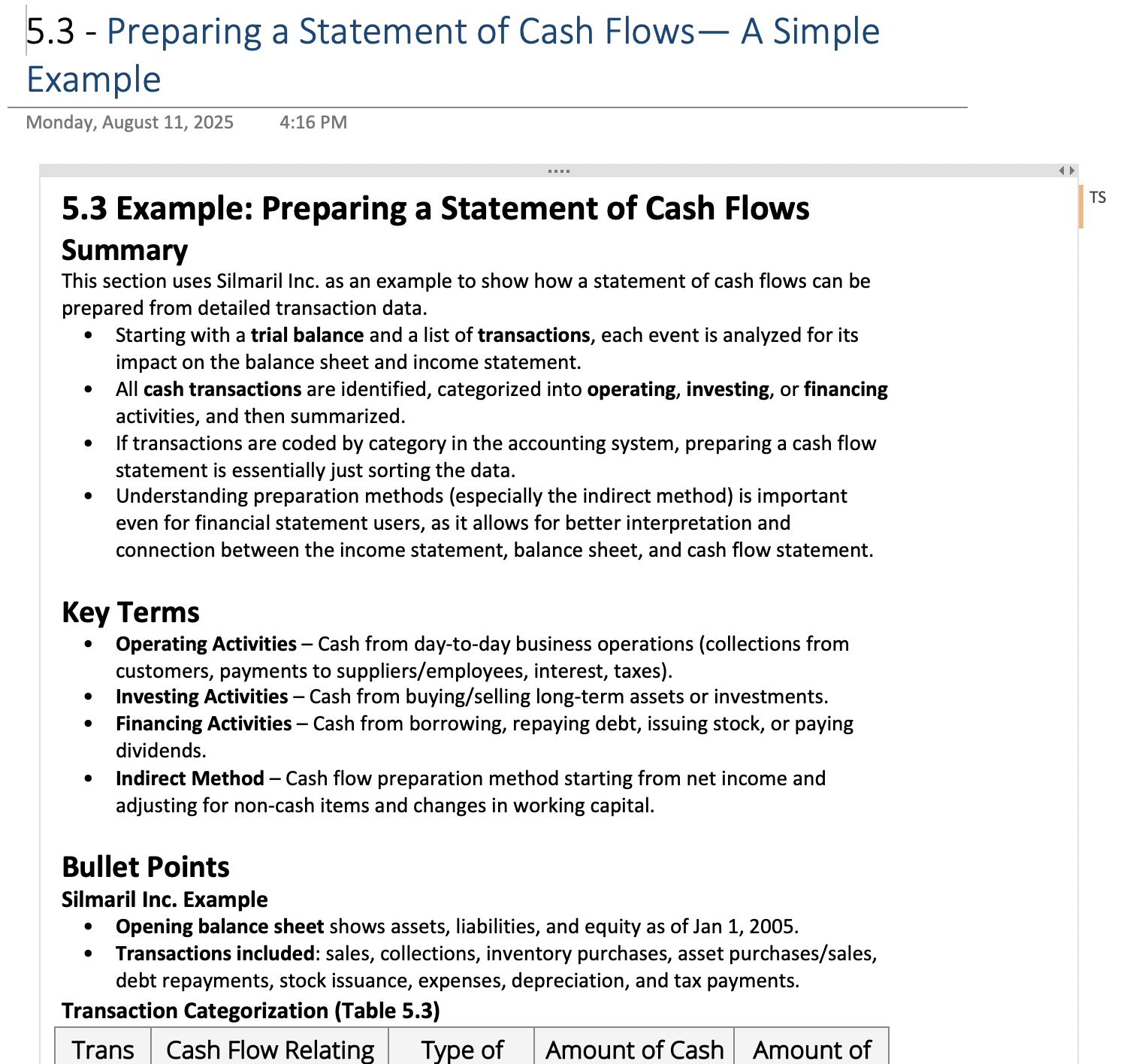
For every section you provide (for example, 4.1 or 11.2), ChatGPT generates notes using the same repeatable structure.
Notes Example in OneNote
Key Concepts
- Bullet-point only
- Captures the main ideas exactly as presented
- No external interpretation or additions
Important Formulas / Relationships
- Only formulas explicitly stated in the material
- No invented math or assumptions
- Ideal for exam review and quick recall
Explanations / Details
- Clarifies meaning using only the provided text
- Preserves definitions and process steps
- Summarizes examples only if they appear in the source
Examples From Text
- No hypothetical scenarios
- No made-up numbers
- Ensures notes remain defensible
Common Pitfalls / Notes
- Included only if the text mentions limitations or cautions
- Helps identify common exam traps
This structure closely mirrors how instructors and exam writers organize questions.
Best Practices: How to Feed Data Into ChatGPT
Even the best prompt depends on how you provide the material. Follow these rules to get the best results.
1. Paste One Section at a Time
Avoid pasting entire chapters.
Best practice:
- One subsection (e.g., 6.2 or 11.4)
- Approximately 1–3 pages of text
This keeps context tight and prevents over-generalization.
2. Use Raw Course Material Only
Always paste:
- Textbook excerpts
- Official PDFs
- Course readings
Avoid:
- Your own summaries
- Highlight-only notes
- Bullet-point outlines
ChatGPT cannot infer missing details.
3. Keep Headings, Tables, and Formatting
If the source includes:
- Headings
- Numbered steps
- Tables or formulas
Leave them intact. Formatting improves accuracy and structure.
4. Don’t Ask Follow-Up Questions Mid-Flow
Let the template do its job.
Avoid:
- “Explain this more simply”
- “Add an example”
- “Compare this to…”
Those requests break the constraint system and invite outside information.
5. Use Consolidation Strategically
After finishing a topic or chapter, use the trigger phrase:
make the consolidated notes
This allows ChatGPT to:
- Combine multiple sections into one study artifact
- Prepare exam-level summaries
- Generate quizzes and review guides later
Who This System Works Best For
This structured ChatGPT prompt works especially well for:
- MBA and graduate programs
- Accounting, finance, and economics courses
- Ethics and management classes
- Certification and exam prep
- Any course where wording matters
If your exams closely mirror textbook language, this approach is ideal.
Final Thoughts: Studying Smarter With ChatGPT
ChatGPT doesn’t replace studying—but it eliminates wasted effort.
With the right constraints, AI becomes:
- A formatting engine
- A consistency enforcer
- A reliable study assistant
Instead of rewriting notes multiple times, you focus on understanding, recall, and application.
If you want to use ChatGPT for studying without hallucinations or fluff, structure—not creativity—is the key.